DataCops vs CHEQ
11 min read
Let's start with the part that surprises everyone shopping CHEQ in 2026…
Simul Sarker
CEO of DataCops
Last Updated
May 10, 2026
DataCops vs CHEQ: the brutally honest 2026 read on go-to-market security
Let's start with the part that surprises everyone shopping CHEQ in 2026. CHEQ is no longer a click-fraud tool. The product page in 2026 calls it the "Intelligence Standard for the Human-AI Era" with six modules: Acquisition, Analytics, Form Guard, Defend, Privacy Enforcement, and Manage. Median enterprise pricing is around $28,000 a year per ClickPatrol's review, with a range of $7,800 to $180,000. No free trial. Mandatory annual contracts. The Jan 30, 2025 acquisition of Deduce added an AI-generated/SuperSynthetic identity fraud module on top of the IVT scoring and form fraud they already had. ClickCease is still around but as the SMB tier ($63 to $124 a month). The ClickCease acquisition happened in 2020, not 2024 like some pages still say.
Most "CHEQ alternative" pages on the internet haven't caught up. They list ClickCease and ClickGUARD and Lunio as if CHEQ is still a Google Ads click filter. CHEQ moved upmarket. The new pitch is go-to-market security, which is a marketing term for IVT scoring + form fraud + identity fraud + privacy enforcement, sold to enterprise marketing teams that previously stitched four vendors.
The market context is heavy. $63B in global ad spend wasted on invalid traffic in 2025 per MediaPost. Fraudlogix puts global IVT at 20.64% across 105.7B impressions in 2025, with TikTok at 24.2%, LinkedIn at 19.88%, Meta at 8.2%, Google at 7.57%. Lead-gen campaigns run 32% higher invalid-traffic rates than ecommerce. Gaming tops at 18.49%, telecom and utilities at 14.26%. The numbers justify the pivot. The question is whether buying the full CHEQ stack at $28K/year median is the right shape.
This is a brutally honest read on CHEQ in 2026 and where DataCops fits. We built DataCops, so we score it like a peer. 8.5/10. Half-points keep it honest.
Quick stuff people keep asking
What is the best alternative to CHEQ?
Depends on which CHEQ module you actually need. If you only need IVT scoring on Google Ads, ClickCease (still owned by CHEQ) at $63-$124/mo is cheaper. If you want infrastructure-tier bot management, Cloudflare Bot Management runs at 0.3ms detection latency. If you want enterprise IVT certification with the MRC seal, HUMAN Security is the closest peer. If you want CHEQ-grade IVT detection inside the data layer with server-side CAPI and a CMP bundled, DataCops is the integrated mid-market option.
How much does CHEQ cost?
ClickPatrol's 2026 review cites a median of around $28,000/year, with a range of $7,800 to $180,000. No free trial. Mandatory annual contracts. Modular pricing means real cost stacks: paid traffic protection plus form fraud plus identity intelligence plus privacy enforcement is four SKUs.
Is CHEQ worth it for click fraud?
If click fraud is all you need, no. CHEQ moved upmarket in 2025-2026. The cheaper SMB option is ClickCease ($63-$124/mo, same parent company). The enterprise CHEQ price tag is justified only if you're using multiple modules. Buying CHEQ for click protection alone is paying for a six-module stack to use one module.
CHEQ vs ClickCease, which is better?
It's the same company. CHEQ acquired ClickCease in 2020. ClickCease is now positioned as the SMB tier of the same parent. CHEQ is the enterprise tier with the modular go-to-market-security stack. "Better" is a tier question, not a product question.
Does CHEQ block real users?
CHEQ claims a less-than-0.009% false positive rate on the homepage. Capterra reviewers note the dashboard can get confusing and that flagged invalid organic search is informational unless you buy a separate module to act on it. The block-real-users question is mostly a per-deployment tuning issue, same as every IVT scorer.
Is ClickCease owned by CHEQ?
Yes, since 2020. Not 2024. Several alternative-comparison pages still get this wrong.
What is go-to-market security?
Marketing language for the bundle of IVT scoring, form fraud, identity fraud, and privacy enforcement that CHEQ now sells together. Was previously called "paid traffic protection" plus a separate signup-fraud tool plus a separate consent platform. Bundling these is the right product instinct. The price tag and the annual contract are the friction.
The enterprise IVT-and-identity tier
This is where CHEQ now sits. Six modules, median $28K/year, annual contracts, no free trial. The peers in this tier are HUMAN Security and Cloudflare Bot Management.
1. CHEQ
The Good: 2,000+ cybersecurity challenges per visit. Claims less-than-0.009% false positive rate on the homepage. Monitors 1M domains. Processes 6T signals per day. Deduce acquisition (Jan 2025) brings AI-generated/SuperSynthetic identity fraud detection on a graph processing 1.5B daily events from 185M weekly active users with 99.5% accuracy on identity assessments per Deduce's own numbers. Modular product covers Acquisition, Analytics, Form Guard, Defend, Privacy Enforcement, Manage.
Frustrations: Median $28K/year. Range $7,800 to $180,000. No free trial. Mandatory annual contracts. Modular upsell pattern means real cost stacks. Capterra reviewers say the dashboard "can get a bit confusing and overwhelming" and that invalid organic search detection is just informational unless you buy a separate module to act on it. ClickCease still floats around as the SMB tier creating buyer confusion. CHEQ flags fraud after the pixel fires, so the bad event still hits Meta/Google CAPI in most stacks and trains the bidding algorithms anyway.
Wish List: Self-serve mid-market tier between ClickCease ($1.5K/year) and enterprise CHEQ ($28K+/year). Free trial. Cleaner unbundling so you can buy IVT scoring without the full stack.
Value for Money: 6.5/10. Genuine product if you need the whole stack. Painful price-to-feature ratio if you only need one module.
Pricing: Median $28K/year per ClickPatrol's 2026 review. Range $7,800 to $180,000. ClickCease SMB tier $63-$124/mo as a separate product.
2. HUMAN Security
The Good: Published 2026 State of AI Traffic & Cyberthreat Benchmark. Cloudflare partnership. MRC-certified IVT measurement. Deep enterprise security DNA. Strong R&D on AI-agent traffic classification.
Frustrations: Enterprise sales cycle. Quote-only pricing. Heavy implementation. Overlap with CHEQ on identity-fraud-as-IVT means buyers shop both and pick on relationship.
Wish List: Self-serve tier with published pricing.
Value for Money: 7/10. Best-in-class for the security-tier IVT problem. Wrong shape for SMB.
Pricing: Quote only.
3. Cloudflare Bot Management
The Good: Median 0.3ms detection latency. ML-based fingerprinting without CAPTCHAs. Infrastructure-tier integration if you're already on Cloudflare. Real-time signal at edge.
Frustrations: Bot management is a separate add-on starting around $2,000/mo on top of base Cloudflare. Not specifically built for ad-attribution integrity. Doesn't address the form fraud or identity fraud modules CHEQ bundles.
Wish List: Native ad-platform integration so flagged traffic doesn't poison CAPI.
Value for Money: 7.5/10. Best edge-tier option if Cloudflare is your CDN.
Pricing: From $2,000/mo for Bot Management add-on.
The SMB click-fraud tier (where CHEQ used to live)
This is the old CHEQ. Click filtering for Google Ads accounts at SMB-friendly pricing. Most of the legacy "CHEQ alternative" pages still target this category.
4. ClickCease (CHEQ Essentials)
The Good: $63-$124/mo. Same parent company as CHEQ. Approved Google and Meta API partner. 2,000+ behavior tests per click in 2026. 3-second blocking speed. WordPress on-site protection.
Frustrations: It's the SMB sibling of the enterprise CHEQ stack. "CHEQ vs ClickCease" is the same vendor sold to two markets. The post-acquisition product velocity is fine but the upsell path to enterprise CHEQ is real.
Wish List: Cleaner separation from the parent brand for buyers who don't want to be upsold.
Value for Money: 7/10. Solid SMB click filter. Brand confusion is the friction.
Pricing: $63-$124/mo.
5. ClickGUARD
The Good: Deep rules engine that agencies love. September 2025 rebrand brought new dashboard, AI reporting, and Meta + Microsoft + Performance Max coverage.
Frustrations: Legacy $79/mo users got migrated toward $199/mo equivalents post-rebrand (around 150% lift). G2 reviewers consistently say onboarding takes hours. Conversion tracking gated behind $159/mo Pro tier.
Wish List: Native server-side CAPI passthrough.
Value for Money: 6.5/10. Strong rules engine, dated architecture.
Pricing: $74-$159/mo across three tiers.
6. Lunio
The Good: 15+ ad-platform coverage. Nick Morley CEO since December 2024. May 2026 shipped affiliate fraud detection that validates clicks AND conversions before payouts. Most modern peer in click-fraud category.
Frustrations: Pricing opaque without sales call. Enterprise-shaped.
Wish List: Self-serve tier.
Value for Money: 7/10. Most modern click-fraud peer. Sales-led pricing is the friction.
Pricing: Quote only.
The trust-infrastructure tier (IVT inside the data layer)
The gap. CHEQ flags fraud at the edge. The bad event still flows through your pixel and your CAPI feed, training Meta and Google's bidding algorithms. Then you also pay for a separate consent platform and a separate first-party analytics tool. Three SKUs. Three contracts. Three places consent state can desync.
7. DataCops
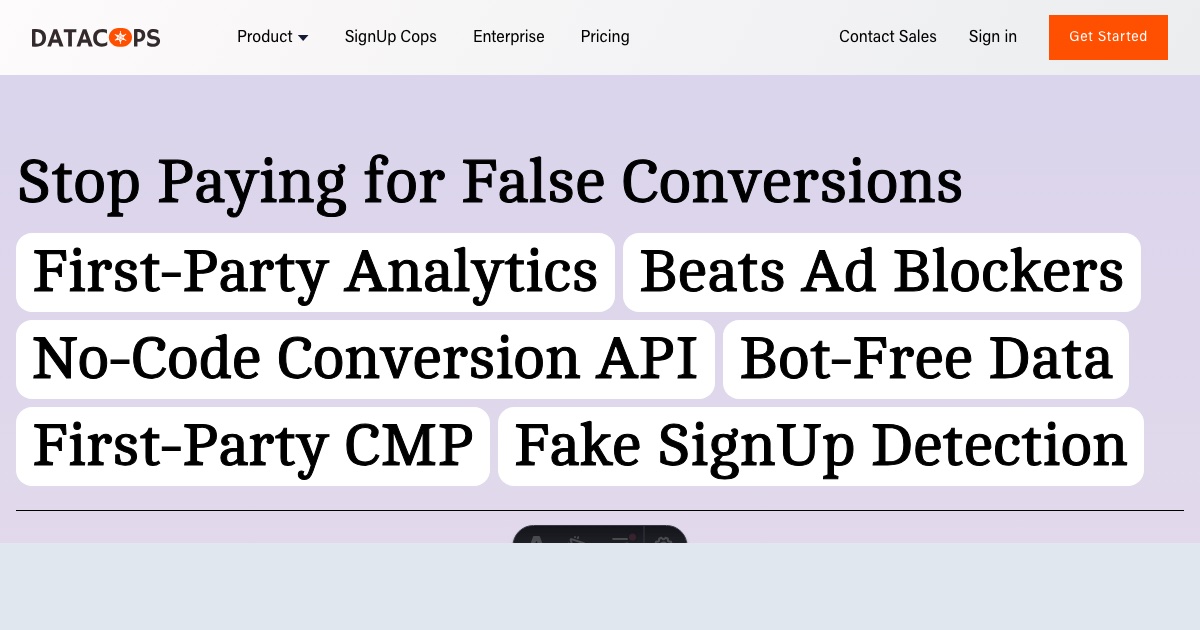
The Good: First-party analytics, server-side CAPI to Meta and Google and TikTok and LinkedIn, bot filtering with 350+ continuous monitoring points, signup fraud detection (SignUp Cops), and a TCF 2.2 certified consent manager share the same backend on a CNAME on your own subdomain. IVT detection happens at the data-layer source. Bot-flagged events don't fire to ad-platform CAPI, so Meta and Google's algorithms only train on verified human conversions. IP reputation database tracks 361B+ IPs and ranges (146.4B+ datacenter, 11.9B+ VPN, 620M+ proxy, 160K+ fraud email domains). Setup in 5 to 30 minutes (one script tag, one CNAME). Free tier covers 2,000 sessions/mo with no card.
Frustrations: SOC 2 Type II is in progress, not active. Google Consent Mode v2 enforcement is in progress. Newer brand than CHEQ. SSO and SAML are planned, not shipped. Doesn't have CHEQ's identity-graph depth (Deduce's 1.5B daily events). MRC certification not pursued (CHEQ-style enterprise procurement gate).
Wish List: SOC 2 Type II to ship. SSO to land. ISO 27001 on the roadmap.
Value for Money: 8.5/10. The only tool here that bundles IVT detection with first-party CAPI and consent on one CNAME backend.
Pricing: Free 2,000 sessions/mo. Growth $7.99/mo (5K sessions). Business $49/mo (50K, HubSpot). Organization $299/mo (300K). Enterprise on quote.
The bolt-on vs native problem
This is the part most CHEQ-alternative pages skip. CHEQ's architecture flags invalid traffic at the edge proxy. The bad event still hits your client-side pixel. Still flows to your tag manager. Still ships to Meta CAPI and Google CAPI as a conversion. CHEQ tells you the click was invalid. The conversion event already trained Smart Bidding on the bot.
This is why the CHEQ home-page claim of less-than-0.009% false positive rate is doing different work than buyers think. False positive rate is about real users not getting blocked, which matters. It doesn't address the false-conversion rate that flows through to the ad platforms after CHEQ's edge decision.
The alternative architecture: filter at the data-layer source. The same backend that flags the IVT also owns the CAPI feed. Bot-flagged events don't get fired. The ad-platform algorithms see only verified human conversions. That's the architectural wedge in 2026.
So what should you actually use?
There's no one-size-fits-all CHEQ replacement because CHEQ in 2026 is six products. Pick on the actual use case.
Want only Google Ads click filtering and you're SMB? Try ClickCease (CHEQ's own SMB tier, $63-$124/mo).
Want deep agency rules engine on Google Ads? Try ClickGUARD.
Want the most modern click-fraud peer with affiliate-fraud detection? Try Lunio.
Want infrastructure-tier bot management at edge if you're already on Cloudflare? Try Cloudflare Bot Management.
Want MRC-certified enterprise IVT measurement for procurement reasons? Try HUMAN Security.
Want CHEQ-grade IVT detection inside the data layer with first-party CAPI and consent on one CNAME backend? Try DataCops.
Want the full six-module CHEQ stack and you can stomach $28K/year median? Buy CHEQ. It's a real product, just expensive.
The mistake I see people make
Buying enterprise CHEQ at $28K/year for a use case that's really just "stop bot clicks on Google Ads." That's a $1.5K/year ClickCease problem (CHEQ's own SMB tier). Or buying CHEQ for IVT and then keeping a separate consent platform (OneTrust at $10K minimum) and a separate first-party analytics tool. Three vendors, three contracts, three places consent state desyncs. The bot-flagged conversion still ends up on Meta CAPI because the data plumbing wasn't unified. The architecturally correct choice in 2026 is one backend that owns the IVT decision, the CAPI feed, the analytics, the consent state, and the form-fraud check.
Related reading:
- DataCops vs Tealium iQ
- DataCops vs HUMAN Security
- DataCops vs Segment
- Server-side GTM enterprise
- Enterprise GDPR compliance platform
Now your turn
What's your CHEQ contract size if you have one? Did the modular pricing land where you expected? And how is your team handling the bolt-on vs native problem with CAPI feeds? Drop the setup in the comments. Specific numbers help the next person sorting through this.