
Make confident, data-driven decisions with actionable ad spend insights.

17 min read
Why third-party tracking collapsed and how to win with first-party data. Build a compliant stack for accurate measurement and sustainable growth.

Simul Sarker
CEO of DataCops
Last Updated
November 30, 2025
I started digging into our analytics dashboards a few years ago, not as an analyst, but as a marketer trying to understand why our ad spend felt like a shot in the dark. The numbers were all there: sessions, bounce rates, conversion goals.
Yet, something felt off. Campaigns that looked like winners on paper failed to produce real business results. The deeper I dug, the clearer it became that the data itself, the very foundation of our decisions, was fractured. We were navigating with a map that had entire continents missing.
What’s wild is how invisible it all is. This data degradation shows up in dashboards, reports, and headlines, yet almost nobody questions the source.

We accept the numbers from Google Analytics or Meta Ads as gospel, never stopping to ask: What percentage of my audience is completely invisible to these tools? How much of my "traffic" is just sophisticated bots burning through my budget?
For two decades, it was built for advertisers, powered by a sprawling, unregulated ecosystem of third-party trackers that followed us from site to site.
That era is definitively over. The new internet is being rebuilt around the user, and businesses that fail to adapt won't just lose data; they will lose trust, relevance, and revenue.
I don’t have all the answers. But if you look closely at your own data, at the gap between what your platforms report and what your bank account reflects, you might start to notice it too.
This is the story of why that gap exists and how the shift to a first-party world is the only way to close it.
For years, the third-party cookie was the engine of the digital advertising economy.
It was a simple text file, but its function was profound: it allowed unknown companies to identify and follow you across the web, building a detailed profile of your interests, behaviors, and intentions. This system, however, was a foundation built on sand.
 A Foundation of Implied Consent
The entire third-party tracking ecosystem operated on a model of implied consent and user ignorance. It worked because most people didn't know it was happening.
Advertisers could target users with uncanny precision, but this power came at a steep cost to privacy. The transaction was imbalanced, and a correction was long overdue.
That correction came not as a single event, but as a multi-front war on third-party tracking.
The change began when privacy shifted from a niche concern to a mainstream demand and a competitive differentiator for the world's largest technology companies.
The first major shockwave was regulatory. The European Union's General Data Protection Regulation (GDPR) in 2018 and the California Consumer Privacy Act (CCPA) in 2020 fundamentally changed the rules.
They mandated explicit, informed consent for data collection and gave users the right to know what data was being held about them. The era of quietly dropping dozens of tracking cookies on a user's browser without their knowledge was over.
The more direct assault came from the browsers themselves. Apple fired the first and most decisive shots with its Intelligent Tracking Prevention (ITP) feature in Safari. Launched in 2017 and strengthened with every subsequent update, ITP aggressively targets cross-site tracking. It works in several ways:
Firefox followed with Enhanced Tracking Protection (ETP), and privacy-first browsers like Brave and DuckDuckGo made blocking their central value proposition. With Google's plan to phase out third-party cookies in Chrome, the final nail is in the coffin.
Parallel to these top-down changes, a bottom-up movement was gaining momentum. The adoption of ad blockers skyrocketed. Today, hundreds of millions of users have extensions that prevent not just ads but also the analytics and tracking scripts that power them. These users are not just blocking interruptions; they are actively opting out of the surveillance economy.
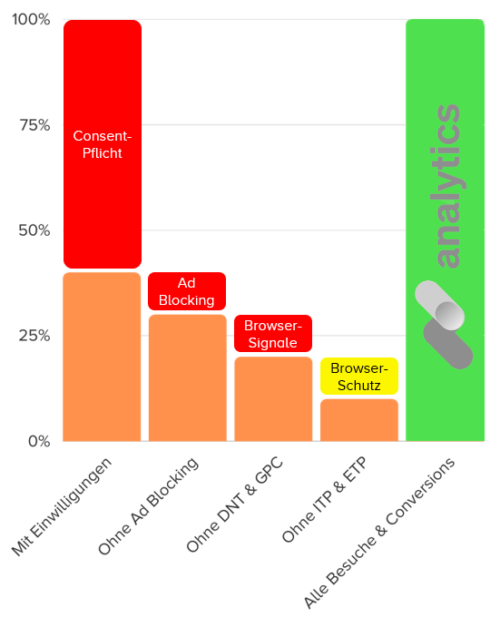
The death of the third-party cookie is only half the story. The real crisis for businesses today is the massive, unreported loss of all data, including what they believe to be first-party analytics. The problem is that most standard analytics tools, including Google Analytics, rely on third-party scripts or scripts that are easily identified and blocked as trackers.
When a browser like Safari or a user with an ad blocker visits your website, they don't just block a few advertising cookies. They often prevent the entire JavaScript file from google-analytics.com or connect.facebook.net from ever loading.
This means:
For that user, you are flying completely blind. Given that Safari accounts for a significant portion of mobile and desktop traffic, especially among high-value demographics, many businesses are missing 20-40% of their user data right from the start.
At the same time your real user data is disappearing, your analytics are being polluted by a growing tide of non-human traffic. Sophisticated bots, designed to mimic human behavior, crawl websites to commit ad fraud, scrape content, or test security vulnerabilities.
They generate fake clicks, inflate session counts, and trigger conversion events, making your data actively misleading.
This is compounded by obscured traffic from VPNs and proxies. While some uses are legitimate, this traffic is often a hallmark of users trying to bypass geo-restrictions or engage in fraudulent activity.
Traditional analytics platforms are notoriously bad at identifying and filtering this junk traffic, leaving you to make critical budget decisions based on corrupted data.
Imagine trying to run a retail store where 30% of customers are invisible and another 20% are mannequins that occasionally move around on their own.
This is the state of digital analytics for most companies in 2024. You are optimizing ad campaigns for bots and failing to understand the journey of your most valuable (and privacy-conscious) human customers.
This creates a dangerous feedback loop: bad data leads to bad decisions, which lead to wasted spend and poor results, all while the dashboard metrics look deceptively stable.
| Metric | Traditional Analytics (The Illusion) | First-Party Integrity Platform (The Reality) | Business Impact of the Gap |
|---|---|---|---|
| Total Sessions | 100,000 | 125,000 (25% recovered) | Underestimating total reach and brand interest. |
| Traffic from iOS/Safari | 15,000 | 40,000 (167% increase) | Massively undervaluing the Apple ecosystem audience. |
| Bot & Fraud Traffic | 5,000 (5%) | 20,000 (16% of true total) | 15% of your traffic is junk, skewing all other metrics. |
| Real Human Sessions | 95,000 | 105,000 | The "top line" number was close, but the composition was wrong. |
| Leads Generated | 2,000 | 2,100 (from real humans) | Some reported leads were from bots; real lead count is different. |
| Cost Per Lead (CPL) | $50.00 | $47.62 (based on real leads) | Overstating CPL due to attributing spend to bot-driven "leads". |
| Conversion Rate | 2.0% | 2.0% (coincidentally similar) | The rate seems the same, but it's based on completely different data sets. |
The only sustainable path forward is to stop renting data from third-party platforms and start owning your data infrastructure.
This is the essence of the first-party data revolution. It's an architectural and philosophical shift toward building a direct, trusted relationship with your users and capturing data in a way that respects their privacy while ensuring its completeness and integrity.
As Joe Stanhope, VP and Principal Analyst at Forrester Research, has emphasized, the strategic focus must change. He states:
"Marketers' obsession with third-party data is ending, and a new emphasis on first-party and zero-party data is taking its place. This is a good thing... It forces marketers to provide value to customers, be transparent, and use the data they collect to improve the customer experience."
This isn't just about collecting more email addresses. It's about fundamentally re-architecting how you see and interact with every visitor.
The core technical solution is to move data collection from an easily blocked third-party context to a trusted first-party one. This means ensuring that your analytics and tracking scripts are served from your own domain.

The most robust and effective way to achieve this is through a first-party proxy, often set up using a CNAME record in your DNS settings. Here’s how it works in simple terms:
analytics.yourdomain.com.analytics.yourdomain.com instead of a third-party domain.To browsers and ad blockers, the script now appears to be a native part of your website. It is treated as a trusted, first-party resource, not a foreign tracker.
This single change allows the script to bypass the vast majority of ITP restrictions and ad blockers, enabling you to reclaim that lost 20-40% of your user data.
This is the foundational principle behind solutions like DataCops, which combine this first-party collection method with advanced data validation.
By serving all measurement scripts from a client's own subdomain, they transform data collection from a vulnerability into a resilient, owned asset.
By 2026, the digital landscape will be firmly divided between businesses that have adapted to the first-party reality and those still struggling with broken, incomplete data.
The winners will not be those who find a clever new way to track users without consent, but those who build a resilient and trustworthy data foundation.
The first step is to stop taking your analytics at face value. Ask critical questions:
Understanding the scope of your data integrity problem is the prerequisite for solving it.

The next step is to adopt a modern data collection architecture. Relying on standard client-side tags from third-party domains is no longer a viable strategy.
| Architecture | How It Works | Resilience to Blockers | Data Completeness | Data Integrity |
|---|---|---|---|---|
| Traditional Client-Side | Scripts from Google, Meta, etc., load directly in the user's browser. | Very Low. Easily blocked by ITP, ETP, and ad blockers. | Low. Significant data loss from a large user segment. | Low. Highly susceptible to bot traffic and ad fraud. |
| Server-Side GTM | A single script sends data to your own server-side container, which then relays it to vendors. | Medium. Reduces client-side exposure, but the initial data capture can still be blocked if not loaded from a first-party context. | Medium. Better than client-side, but still vulnerable at the point of collection. | Medium. Can filter some bad traffic, but requires complex setup. |
| First-Party Proxy (e.g., DataCops) | A single script loads from your own subdomain (via CNAME) and handles collection, validation, and distribution. | Very High. Seen as a trusted first-party resource, bypassing most blockers. | High. Recovers data from iOS, Safari, and users with ad blockers. | Very High. Built-in bot, VPN, and fraud detection cleans data at the source. |
Implementing a first-party proxy solution is the most direct way to solve the data loss and integrity problem in one stroke. This architecture, as used by DataCops, not only ensures the script loads but also provides a critical checkpoint to filter out fraudulent traffic before it ever pollutes your downstream systems. For a deeper look at how this validation works, you can explore the principles of human analytics. [Hub content link]
Collecting clean, complete data is the first half of the battle. The second is making it actionable. A true first-party strategy involves sending this high-integrity data to the platforms where you make decisions.
In a first-party world, trust is your most valuable asset. The goal is not to track users secretly but to collect data transparently and with their permission. This is where a robust Consent Management Platform (CMP) becomes non-negotiable.
However, just like analytics scripts, CMPs can also be blocked if they are loaded from a third-party domain.
The superior approach is to integrate consent management directly into your first-party architecture. A first-party CMP, like the TCF-certified one included with the DataCops platform, is served from your own domain, ensuring it is always available to manage user consent properly and in compliance with regulations like GDPR.
This approach aligns your business with the core principle of the modern web, as articulated by scholar Shoshana Zuboff, author of The Age of Surveillance Capitalism:
"The challenge is to tame the digital, to subordinate it to our society and to our democracy. That's the work of this century."
By choosing transparency and robust, consent-driven data collection, you are not just complying with regulations; you are aligning your business with the future of a more equitable and democratic web. For more on navigating this complex landscape, see our guide on compliance. [Hub content link]
The tectonic plates of the internet have shifted. The era of building a business on rented land, relying on the data and infrastructure of third-party trackers, is over.
The constant algorithm changes, the browser wars, and the regulatory crackdowns were not isolated events; they were symptoms of a fundamental model breaking down.
Attempting to find the next loophole or workaround is a losing game. The only winning move is to change the game itself.
The future belongs to businesses that build their own "data fortress" on a foundation of first-party data.
This means investing in an architecture that ensures data is complete, clean, and collected with user consent. It means shifting your mindset from harvesting data to earning it through value and transparency.
By 2026, the companies that thrive will be those who have an end-to-end, owned view of their customer's journey, from the first anonymous visit to the final conversion.
They will make better decisions, spend their budgets more wisely, and build deeper, more resilient customer relationships. They will have stopped renting a distorted view of their audience and started owning the ground truth.
Answer: The "death" of third-party cookies isn't a single event but a combination of three massive shifts:
Regulatory Pressure: Laws like GDPR and CCPA now demand explicit user consent, making the old model of "implied consent" illegal.
Browser Warfare: Browsers are actively blocking trackers to protect users. Apple’s Safari (Intelligent Tracking Prevention) and Firefox (Enhanced Tracking Protection) block third-party cookies by default.
User Action: Millions of users now install ad blockers that prevent analytics scripts from ever loading.
Answer: You are likely losing 20-40% of your data. Standard analytics tools (like Google Analytics or Meta Pixel) rely on third-party scripts that are easily identified and blocked by Safari, iOS, and ad blockers. This means you are "flying blind" for a huge portion of your high-value audience (especially iPhone users), resulting in zero record of their sessions, page views, or conversions.
Answer:
Client-Side (Traditional): Scripts load directly from a third-party domain (e.g., google-analytics.com). This is Low Resilience—it is easily detected and blocked by browsers, leading to massive data loss.
First-Party Proxy (The 2026 Winner): This method uses a CNAME record to serve tracking scripts from your own domain (e.g., analytics.yourbrand.com). To browsers and blockers, the script looks like a trusted, native part of your website. The article highlights this as the only "Very High Resilience" architecture that recovers lost data.
Answer: Not entirely. The article rates Server-Side Google Tag Manager (GTM) as having only "Medium" resilience. While it moves some processing off the user's device, the initial data capture can still be blocked if the script isn't loaded from a trusted first-party context. A true First-Party Proxy (like the architecture used by DataCops) is required to ensure the script loads successfully and to filter out bad traffic before it reaches your server.
Answer: Bot traffic creates a "distorted view of reality." The article notes that without proper filtering, your analytics are polluted by bots (scrapers, ad fraud) and VPN traffic.
The Impact: You might see 100,000 sessions, but 16% could be junk. This deflates your conversion rates and inflates your Cost Per Lead (CPL) because you are unknowingly optimizing your ad spend for "mannequins" rather than real humans.
Answer: It is the shift from "renting" data to owning it. Instead of relying on third-party platforms (which are losing signal), the revolution involves building your own "data fortress." This means using a first-party infrastructure to collect complete, clean data directly from your users (with consent) and then feeding that high-quality data back into your ad platforms (Google/Meta) and CRMs (HubSpot) to improve performance and attribution.
Answer: The winners in 2026 will be businesses that adopt a First-Party Architecture. Success will rely on three pillars:
Resilience: Serving scripts from your own domain to bypass blockers.
Integrity: actively filtering out bots and fraud before data enters your dashboard.
Trust: Using a first-party Consent Management Platform (CMP) that is transparent and compliant, ensuring you build relationships rather than just tracking clicks.